

Understanding Products: Operational use of Bunsen burners:
Selecting the Burner:
Please see our Undertanding products on Bunsen burners to select the right type for you.
http://www.hbarsci.com/blogs/news/10099273-understanding-products-bunsen-burners
One important thing to note is that there are 2 different fuel sources for bunsen burners that have different specification for the flame produced.
1. Natural Gas Burners
2. Liquid Propane Burners
3. Meker Burners are slightly different:
All Eisco Scientific burners have a 6-8mm Tubing size.
Bunsen Burners Available from hBARSCI:
|
Burner Type |
Natural Gas Number |
Liquid Propane Number |
Gas Throttle on Burner |
Comments |
|
Basic Burner |
N |
Very basic simple easy to use burner, usually selected based on price. |
||
|
Burner with Flame Stabilizer |
N |
Most common basic academic burner with air flow control |
||
|
Burner with Flame Stabilizer and Gas Adjustment |
Y |
Best selling an most used burner due to the flexibility to control the gas and air flow to the flame. |
||
|
Micro Burner |
Y |
Great burner when space and height are a concern. |
||
|
Meker Burner |
Y |
The burner people turn too when then need a flame hotter than the usual bunsen burner. |
||
|
Tirrill Burner |
Y |
Burner selected due to the easy of finely controlling the air gas mixture to flame. |
Safe Operation:
1. Always use the correct fuel type for your burner. Natural gas burners are to only use a NG source and Liquid Petroleum (propane) burner only with a LP source.
2. Do not wear and loose clothing, ties, necklaces, ID badges or anything that might dangle off your body as it can be caught easily in the flame.
3. Hair must be tied back and securely fastened.
4. A lab coat and safety googles must be warn.
5. It is also recommended that insolated gloves be worn while heating or removing objects over the flame.
6. Only use Bunsen burner approved stands to hold objects over the flame.
a. http://www.hbarsci.com/products/ch0647b?variant=1298911896
7. To heat a beaker a ring stand covered in wire gauze should be used.
a. http://www.hbarsci.com/products/ch0525?variant=514147061
8. To heat a test tube a test tube clamp should be used.
a. http://www.hbarsci.com/products/testtubeclamp?variant=353843935
Warning:
The Bunsen burner is able to reach very high temperatures. Anything in contact with the flame including the tip of the burner itself will remain hot long after the flame is shut off. Do not put anything near or touching the objects in contact with the flame until it has completely cooled.
Never leave a Bunsen burner unattended.
Before you Begin :
- Check your tubing for any cracks, pinch points, holes or damage of any kind. If the tube is damaged, discard the tube and get a new one. If the end of the tube in uneven, you should cut off the uneven part and throw it away to get a clean edge.
- Find a work area away from any overhead shelving, equipment or light fixtures by at least 12 inches.
- Clear the work area of any extra materials, anything combustible, papers or notebooks.
- Gather all materials and supplies you will need to conduct your experiment and have them at arm’s reach before you connect your Bunsen burner. This includes a sparker/lighter.
- Double check yourself for any loose clothing or any object such as ties or necklaces that dangle. Wear appropriate safety equipment.
- Make sure any other person in the laboratory knows you will be turning on the Bunsen burner.
Set Up:
- Connect the tube to the gas supply nozzle on one end and to the gas inlet on the other end.
- Close the air ports by twisting to the left.
- Turn on the gas all the way. Do not adjust the flame by using the gas valve.
- Strike the sparker/lighter about 5 cm above the top of the Bunsen burner until it lights.
- If using a match, light the match and bring the lit match alongside the barrel of the burner and raise it slowly over the edge of the barrel from the side.
- Adjust the flame by slowly twisting the airport until the flame is the correct temperature for your experiment.
Safety Flame , This flame is easy to see and allows others to remember that your bunsen burner is on. It is not used for heating materials for an experiment.

Medium Blue Flame .
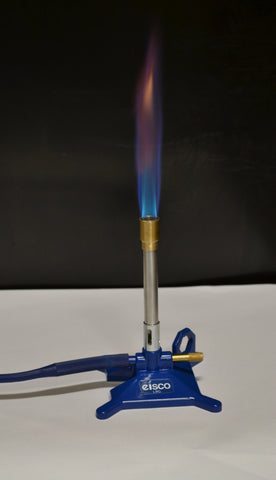
Roaring Blue Flame
(This is the only flame that makes noise) It is the hottest flame with the hottest part of the flame being just at the tip of the white cone in th middle of the blue flame.

When Finished :
- Shut off gas when the experiment is finished
- Wait until all objects in contact with the Bunsen burner as well as the tip of the Bunsen burner itself is completely cool before putting objects away or handling it.
By no means do we condone or recommend using a bunsen burner with a propane gas tank off of a gas grill (bbq grill), but we do receive the question never the less and we had a customer do a write up on how they set theirs up. Please note that this is dangerous and not condoned and is especially dangerous if there is a gas leak.

Set up In order from tank to burner:
Tank- Typical gas grill propane
-Net weight 15lbs (6.8kg)
-gas output on non-safety tank that is unregulated varies with temperature (70F-~122 PSI , -44F~0 PSI)
Regulator- Brickman gas grill regulator
-Model # : RA329
-Pressure rate : 1 PSI
-End fitting 5/8 -18 UNF

Brass Fitting 1 -3/8FL x 3/8MPT connector (True value sku: 122984)

Brass Fitting 2 - 3/8 brass coupling (True value sku: 122836)

Brass Fitting 3 -3/8ID x 3/8MIP brass hose barb (Watts brand Model #LFA294)
Hose

-Eisco neoprene tube 90cm (sku# ch0100b)
Burner

-Eisco No Tip Bunsen Burner, Flame Stabilizer, Gas Adjustment, Liquid Propane (sku#ch0993lp)

To be applied @ each brass to brass connection is gas line sealant tape.

-Material: PTFE
-Density: 1.2-1.5sg
-Color: Yellow
-Pressure range:0-2250
-Temp range: -400f-550f


